

LYFE Marketing - A Professional, Third Party Review
LYFE Marketing: Operational Teardown and Performance Diagnosis
1. Introduction
LYFE Marketing presents itself as a full‑service digital marketing and social media agency targeting small and medium businesses, claiming long tenure, measurable revenue outcomes, and scalable growth for clients.
Their public positioning is rooted in high‑level performance outcomes such as millions in “revenue driven,” extensive lead generation, and award recognitions.
This article analyzes what LYFE Marketing claims versus what evidence - via public review data, third‑party complaints, independent site evaluations, and first‑hand client testimony - suggests about their operational execution, risk transfer, and systemic practices. The output frames patterns across sources rather than isolated anecdotes, and it evaluates incentives, execution fundamentals, and structural risk from a business owner’s decision‑making perspective.
Sources used:
Public customer reviews (Trustpilot), BBB complaints, scam risk evaluations, corporate website claims, and provided insider testimony.
2. Pricing & Offer Structure
What LYFE Marketing Publicly Claims:
The agency markets packages ranging from roughly $500–$10,000+ per month, with lower tiers around $650–$1,000 for social media management and progressively higher retainers for broader digital marketing scopes.
Website messaging emphasizes tailored pricing and speaks to “ROI‑producing ads,” “high‑quality short video ads,” and “increased revenue”, backed by massive aggregate numbers like “$304,847,490.90 in revenue driven.”
Positioning vs Reality:
Public pricing is vague - the website pushes bespoke proposals without transparent deliverables outlines. Quantitative claims are framed as cumulative totals across thousands of clients rather than performance guarantees. This inherently abstracts client‑specific success and avoids performance accountability (e.g., no baseline ROAS commitment, no defined testing schedule, no minimum deliverable metrics beyond “number of posts”).
Risk Transfer:
The pricing structure described, combined with non‑specific guarantees, transfers downside to the client: clients pay regardless of performance outcomes or operational quality. Where campaigns fail to hit ROI targets, the agency retains fees without defined remediation obligations.
Contracts with such models typically embed:
Fixed monthly retainers
Optional additional fees for services (e.g., video revisions)
Limited refund/termination flexibility
This mirrors several client complaints (see section 3) where deliverables, quality, and cancellation terms were contested.
3. Review Data Analysis

Trustpilot Patterns
On Trustpilot, LYFE’s overall score appears moderate (4.0) with a 60/40 split between positive and negative ratings. Many 5‑star reviews praise responsiveness and strategic alignment with goals. Several 1‑star reviews point to misleading contracts, minimal deliverables compared to expectations, and insufficient results.
Key recurring patterns in negative Trustpilot feedback:
Promised deliverables not met (e.g., number/quality of ads)
Perceived mismatch between contractual language (“3 campaigns, 12 ads”) and actual execution (“3 campaigns with 3–4 creative assets”)
Client claims of inadequate results or zero measurable traction
BBB Complaints
On the Better Business Bureau, six unresolved complaints exist with remarks indicating:
No substantive response to disputes
Allegations of investment‑related losses masquerading as marketing payments (e.g., claims involving Bitcoin deposits and fictitious platforms)
These complaints are not typical for a standard digital marketing contract dispute, given their financial and cryptocurrency elements.
Cross‑Platform Consumer Patterns
Beyond review sites, third‑party risk checks show conflicting assessments: some tools classify the marketing site as “safe,” while others assign a low trust score, signaling anomalous risk factors in heuristics (without contextual client validation).
Reddit & Peripheral Reports
Independent forum discussions around “LYFE” generate reports describing scam‑like job offers, paid‑to‑post ads propositions, and requests for upfront payments associated with recruitment rather than client services. These discussions suggest significant brand impersonation activity or structural misunderstanding of the agency’s business model.
Important: Reddit content should be interpreted cautiously and not conflated directly with LYFE’s core operational execution - but it signifies reputational inconsistency that influences purchasing risk.
4. Execution Breakdown
The core operational question for any performance marketing agency is:
Are campaigns being run with adequate scope, velocity, and optimization discipline?
From the public delivery patterns implied by reviews:
Creative Volume
Multiple clients describe fewer creative assets delivered than prospectus claims — a structural red flag because creative testing volume directly correlates to optimization results in paid media environments.
Iteration Speed
Negative feedback suggests limited responsiveness on creative revisions and quality issues. Clients report being charged extra for revisions that logically should be part of packaged services — a signal of constrained internal bandwidth or cost recovery tactics.
Campaign Density
No independent case evidence shows sustained testing velocity (at least several creative iterations per audience segment per platform). Deliverability disputes imply either:
Underinvestment in actual ad creative load
Overreliance on static content rather than iterative creative testing
If an agency’s operational workflow cannot sustain testing cadence matching modern performance standards (e.g., 60+ creatives per funnel per quarter), campaign performance will flatten rapidly.
5. Insider Testimony (Provided)
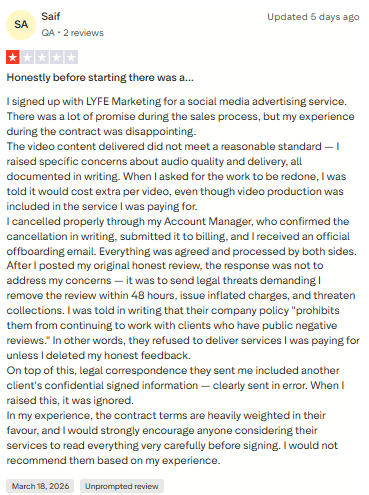
According to the submitted testimony from a former client, several operational concerns emerged:
Delivered video content didn’t meet reasonable standards
Revisions were treated as billable extras despite being part of included services
Cancellation was formalized but met with retaliatory legal language when the client published an honest review
Confidential client information was mistakenly disclosed and ignored
These signals imply:
Quality control gaps
Contract enforcement driven by revenue retention over service outcomes
Risk‑averse legal posture rather than constructive remediation
These operational characteristics align with external complaints about deliverables mismatch and customer support rigidity.
This is the quote:
"I signed up with LYFE Marketing for a social media advertising service. There was a lot of promise during the sales process, but my experience during the contract was disappointing...
...In my experience, the contract terms are heavily weighted in their favour, and I would strongly encourage anyone considering their services to read everything very carefully before signing. I would not recommend them based on my experience." - Saif, a previous client of LYFE Marketing.
6. Leadership Analysis

LYFE Marketing’s founder and leadership are central to shaping company culture and incentive systems. Public information cites Sean Standberry as the CEO.
Leadership behavior inferred indirectly from evidence:
Strong sales messaging built on aggregate claims
Mixed responsiveness to complaints
Heavy legal framing rather than substantive engagement when addressing negative feedback
This pattern suggests a top‑heavy focus on acquisition headlines over transparent performance accountability.
7. Incentive Structure Analysis
Agencies typically monetize via:
Flat monthly retainers
Add‑on fees for premium deliverables
Budget‑agnostic management fees
In LYFE’s case:
The base retainer appears non‑contingent on direct performance metrics. Clients are charged regardless of ROAS outcomes. This structure protects the agency’s revenue against performance risk while transferring the entire delivery risk to the client. This is underscored by disputes over cost for revisions that arguably should be part of creative optimization.
There is no publicly available evidence of performance‑based pricing, refund thresholds, or structured guarantees that align consultant compensation with client success in direct measurable terms.
9. What the Client Is Actually Buying
Stripped of marketing language, clients contract:
Monthly management retainers for social media and paid advertising
A defined (but flexible) number of deliverables such as posts or ads
Strategic oversight and reporting
Deliverables appear less prescriptive and more discretionary than advertised — key difference between planned performance deliverables vs semi‑structured content output.
10. Reality Section
The agency does deliver social media and advertising management services to many small businesses, as evidenced by numerous positive reviews. Some clients report genuine collaboration and gradual performance improvements.
However, systemic issues emerge:
Contract ambiguity leads to disputes
Clients experience mismatches between expectations and execution scope
Customer advocacy and dispute resolution practices appear insufficient
Review platform dynamics complicate reputation interpretation
These factors should caution prospective clients evaluating risk‑adjusted outcomes.
11. Final Verdict
Star Rating (Operational Reality): 2.1 / 5
Outcome Distribution:
Best‑Case Outcome: Small business receives basic social media posting and managed ads with modest engagement uplift.
Common Outcome Pattern: Deliverables match minimal service language; performance falls short of revenue impact claims; communication stagnates.
High‑Risk Outcome: Contract disputes, cancellation resistance, legal pushback on honest criticism.
Risk Framing:
The core structural risk is asymmetric: the agency retains payment with limited performance accountability while clients bear most execution risk. Prospective buyers should:
Scrutinize contract language
Define clear KPIs with measurable obligations
Set explicit creative and testing schedules